If you have, bring your Web of Science credentials
1:30-3:00
From Research to Policy: An Introduction to Overton, with Nathalie Cornée from Overton Event completed.
3:15 - 4:45
Using AI for Research Impact, with by Mike Taylor, Emily Hart from Digital Science. Event completed.
5:00 - 8:00
CARL COPPUL Event:
In celebration of BRIC and this opportunity to have a large group of like-minded people in Edmonton, CARL (Canadian Association of Research Libraries) and COPPUL (Council of Prairie and Pacific University Libraries) are inviting all BRIC registrants and anyone working or interested in scholarly communications, academic publishing, and research assessment to a social event on Tuesday evening at The Common.
Detailed program with bios and abstracts (PDF v 1.0). Attended BRIC? Please give us your feedback.
Wednesday June 3rd
8:00 – 9:00
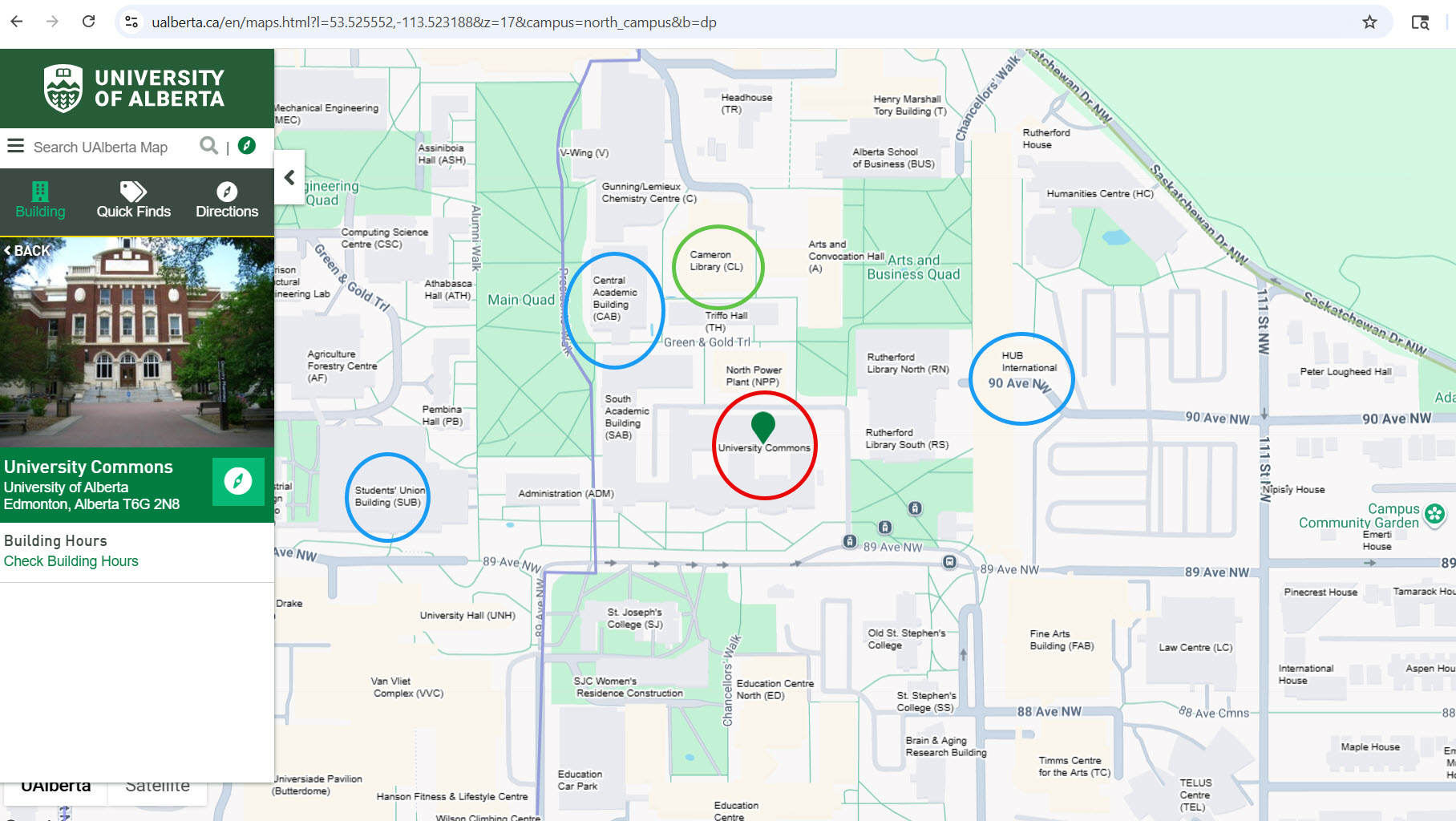
Arrivals, badge pickup; light continental breakfast from 8:15 – 8:55 at University Commons room 2-350 (Alfred Sorensen Community Hall)
9:00 – 9:10
Welcome & Introductions, University Commons, room 2-350 (Alfred Sorensen Community Hall), with Dr. Dale Askey, Chief Librarian, University of Alberta
9:10 – 9:30
Re-evaluating Research Impact: Aligning Academic Metrics with Conservation Outcomes in Canada, Christie Hurrell, University of Calgary
9:30 – 9:50
Breaking Through the Technical Hurdles of Research Impact Reporting, Emily K. Hart, Syracuse University
9:50 – 10:10
Reorganizing Canadian Research Evaluation through Metadata in the Digital Era, Quintin Kreth, York University
10:10 – 10:40
Break & Posters: For Day 1 only – Coffee, posters in Cameron Library, Fireside Lounge
10:40 – 11:20
The Open Access Advantage – how does it work, and how do we make OA work for us?, Mike Taylor, Digital Science
11:20 – 11:40
Do Policymakers Cite or Mention? Investigating Formal vs Informal Research Engagement in Policy Documents and the Implications for Responsible Research Assessment, Nathalie Cornée, Overton
11:40 – 12:00
Understanding Faculty Perceptions Towards Policy Citations: A case study of the University of Minnesota and the University of New Brunswick, Julie Morris (UNB) and Andy Herzog (UM)
12:00 – 1:20
Lunch & Posters – Lunch in University Commons, room 2-350 (Alfred Sorensen Community Hall). Posters in Cameron Library, Fireside Lounge
Optional: Lunchtime tour of the University of Alberta Library’s Bruce Peel Special Collections, 12:30 to 1:10. Maximum of 10 participants; sign up will be at the registration table.
1:20 – 1:40
Reporting Practices in Modern Bibliometric Analyses: A Review of the Most Cited Papers 2020-2024, Erin Simon, University of Illinois
1:40 – 2:00
Uncovering institutional affiliations: Utilizing modern data sources to enrich a bibliographic collection built on legacy software, Elisabeth Shook, University of Michigan
2:00 – 2:20
Put a PID On It: Enhancing OA Reporting for Good, Nikolas Lamarre, CRKN, Allison Loveridge, CRKN
2:20 – 2:40
From Uncharted Waters to a Mapped Horizon: Building a Research Intelligence App with Power BI and Integrated Open and Institutional Data,Karina Giesbrecht, University of Victoria
How Well Are Social Work Scholars Represented? Assessing Author Profiles across Bibliometric Platforms, Leah DeSantis, University of Washington
3:30 – 3:50
Scientific Relatedness Constrains Novelty in Global Sustainable Development Goals Research, Robin Haunschild, Max Planck Institute for Solid State Research, Meijun Liu, Fudan University
3:50 – 4:10
The changing global research landscape reflected in multi-faceted bibliometric data: Introducing the Institute of Scientific Information’s PESTLE model within the Societal Impact Framework, Marisa Ruccolo
6:00 - 9:00
Reception at the Art Gallery of Alberta
Thursday June 4th
8:00 – 9:00
Arrivals, badge pickup; light continental breakfast from 8:15 – 8:55 at University Commons room 2-350 (Alfred Sorensen Community Hall)
AI-Driven Bibliometrics for Research Impact: Mapping Canada’s Strategic Technology Opportunities, David Campbell, Elsevier
11:00 – 11:40
Data citation function classification with large language models (LLMs), Neil Byers, Berkeley Lab
11:40 – 12:00
Critically Evaluating the Impact of Transformative Agreements, Jason Friedman, University of Saskatchewan; Leigh-Ann Butler, University of Ottawa
12:00 – 1:20
Lunch (University Commons, room 2-350 (Alfred Sorensen Community Hall))
1:20 – 1:40
An Analysis of Undeclared Artificial Intelligence and the Communication Practices of Academic Journals, Miles Kenyon, University of Toronto
1:40 – 2:00
The Great Convergence: Where GenAI, Expertise, Fundraising Connect, Dieyun Song, Northwestern University
2:00 – 2:40
A Longitudinal Analysis of Sentiment Temporal Changes, Drift and Controversy in over 150 Million Altmetric Social Media Mentions of the past decades (2005-2025), Mike Taylor, Digital Science
Research Impact in a Chaotic Political Landscape: Maintaining Services When Priorities Shift, Andrea Malone, University of Houston
4:10 – 4:30
Connecting metrics to meaning – Visual storytelling of an Institute’s impact across five pathways, Deeksha Bhardwaj, The George Institute for Global Health
Posters
Posters in Cameron Library, room 3-10 on day 1; University Commons 1-090 day 2.
A Systematic Bibliometric Review of Topic Modeling Applications in HSS in Support of Library Services, Leslie Barnes, University of Toronto
Measuring open science practices with the PLOS Open Science Science Indicators dashboard, Devin Soper, PLOS
The quiet drift: Witnessing academia’s slide into AI-mediated scholarship, Jeffrey Demaine, BRIC
Practitioner education in Bibliometrics: The LIS-Bibliometrics case study, Barbara S. Lancho Barrantes, University of Brighton; Michelle O’Hara, University of Glasgow; Behrooz Rasuli, Iranian Research Institute for Information Science and Technology
Collaboration Writ Large, Pat Moore, Carleton University
Using bibliometrics tools to braid together the past, present, and future, Thane Chambers, University of Alberta
Better together: Tracking research outputs & assessing accessibility, Gwynn Hill, Cassandra Larose, Dipa Barua; Royal Roads University